Muslim travel in Japan, made practical
You want a trip to Japan that respects your faith without turning every meal into a puzzle.
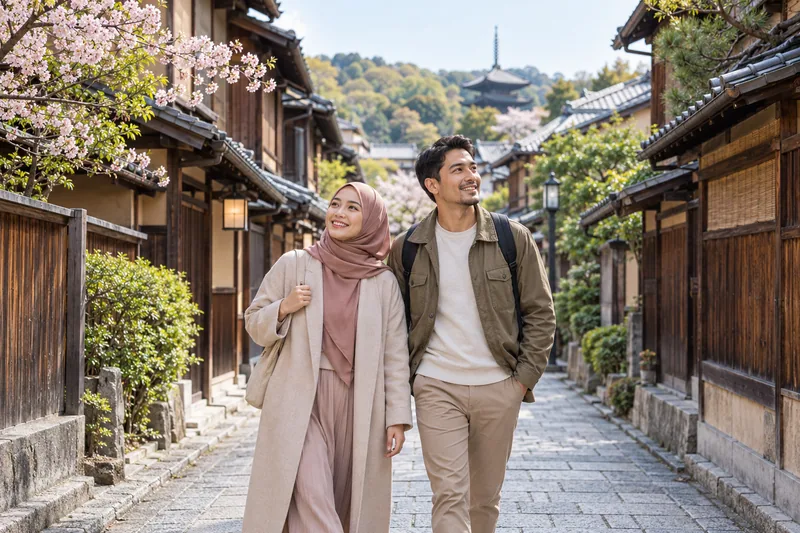
Japan can work very well for a Muslim family, as long as you plan meals and prayer instead of hoping they will turn up. Halal food exists, mostly in the big cities, and it comes with very different levels of proof. This page shows you how to read those levels and where the gaps are.
Who is Japan right for?
Japan suits travellers who like order, clean public transport and a plan. First-timers, couples and families with children usually find the trains easy to follow and the streets calm. It asks more of you if you eat only certified halal, because pork and alcohol sit inside ordinary Japanese cooking.
Muslims are a very small share of the population. Pew Research estimated 0.1% in 20103. So do not expect a halal option or a prayer room around every corner.
What do Malaysians need to enter Japan?
Malaysian citizens do not need a visa for a short stay of less than 90 days1. Rules change, so check the official page before you fly.
You can also pre-register immigration and customs details on Visit Japan Web and show QR codes at checkpoints2. Confirm the current steps on the Japanese government site.
Food in your luggage needs care. Japan’s agriculture ministry prohibits meat products as a rule, even heat-treated ones12.
Trying to bring them in can mean a fine of up to three million yen or imprisonment for up to three years13. Leave the sausages, rendang packs and meat-flavoured snacks at home.
What does halal really mean in Japan?
It depends on who is saying it. JNTO, Japan’s national tourism body, states that there is no central agency for halal accreditation in Japan, so you should check each provider’s claims4. Here is how the claim states look on the ground.
- Certified halal: a recognised body issued a certificate you can see. JAKIM’s 21 August 2026 list recognises six Japanese bodies: JMA, JHA, JIT, MPJA, NAHA and JHF5. Check the issuing body, the expiry date and whether it covers this branch and kitchen.
- Operator-declared halal: the restaurant says so, and you have seen no certificate. Ask what they mean by it.
- Muslim-owned: run by Muslims. That is reassuring, but it is not the same as certified.
- Muslim-friendly: some needs are considered. JNTO notes that such restaurants may not have a separate halal-only kitchen, and that alcohol is served in most Japanese restaurants6.
- Pork-free, seafood or vegetarian: no pork on the menu, but the kitchen and suppliers are unchecked. JNTO warns about cooking sake and mirin in Japanese dishes, and about miso that contains alcohol unless it is labelled additive-free (mu-ten-ka)7.
- Unknown: nobody has shown you evidence. Unknown is never the same as halal.
Our guide to Japanese certification bodies explains how to read a certificate photo before you go.
Where do you pray in Japan?
Honestly, it takes some planning. JNTO says prayer rooms and mosques are mostly in larger cities, with major airports, tourist hotspots and Muslim-friendly hotels increasingly offering places to pray8.
Two mosques you can build a day around are Tokyo Camii in Shibuya, whose current building was completed in 20009, and Kobe Mosque, founded in 193510. At Haneda, the airport’s own site lists no prayer room in Terminal 111, so know your terminal before you land.
Between sights, pray at your hotel before you leave and again when you return. Mark the qibla (the direction of the Kaabah in Makkah, which you face to pray) on your phone compass in each room. Our praying in Japan guide lists the options city by city.
Where should you base yourself?
- Tokyo: the widest choice of halal food and prayer spaces, with Tokyo Camii close to Shibuya. See Tokyo for Muslim travellers.
- Osaka: food-focused and an easy base for day trips. See Osaka for Muslim travellers.
- Kyoto: slower and temple-heavy, with fewer halal restaurants, so book meals ahead and pray at your lodging.
Stay near a main railway station. It saves your legs and keeps a prayer room or a hotel room within reach.
Dress, customs and daily life
Modest dress and hijab draw little attention. Shoes come off in homes, some restaurants and traditional lodgings, so wear socks you are happy to show.
Onsen (hot-spring baths) are used without clothes, so book a room with a private bath if that matters to you. For emergencies, JNTO lists 110 for police and 119 for fire and ambulance14.
For families, older parents and solo women
Children and older parents cope well with Japan’s trains, but station stairs and long walks add up. Build in a hotel rest each afternoon, which also gives you a calm place to pray Zohor or Asar. Solo women and women-only groups should save the address of each lodging in Japanese, and look for rooms close to a station.
Ramadan and festive timing
Fasting in Japan is possible, but iftar needs a plan, because few restaurants are open with a halal menu at the moment you break fast. Ramadan and Hari Raya dates depend on moon sighting, so confirm them with JAKIM before you book. Malaysian school holidays and Raya weeks are busy for flights and hotels.
When might another place suit you better?
If you want certified food at almost every meal with little checking, Taiwan may feel easier, and our Taiwan guide shows why. If you are weighing Japan against Korea, read Japan vs South Korea: which makes halal meals easier.
How does Japan fit a route?
A classic first route links Tokyo, Kyoto and Osaka. Our seven-day Tokyo, Kyoto and Osaka plan shows how to place meals and prayer around that loop. For more places across the region, browse our country and city guides.
If you tell us your cities, your family and how strict your meals are, we can sketch a Japan route with the prayer and meal gaps already marked.
Common questions
Is halal food easy to find in Japan?
In Tokyo, Osaka and Kyoto you can find restaurants that show a certificate, some run by Muslims and some that only avoid pork. Outside the big cities choices thin out fast. Plan the day's meals in advance, carry back-up food, and treat any place without a certificate as unconfirmed.
Do Malaysians need a visa for Japan?
Malaysians do not need a visa for a short stay of less than 90 days. Rules can change, so check the official Japanese government page before you fly. Entry steps such as pre-registering through Visit Japan Web are worth doing at home, where you have a good connection and time.
Can I trust a 'Muslim-friendly' sign at a Japanese restaurant?
Treat it as a starting point, not proof. The label can mean a prayer mat, an English menu or a pork-free dish. Ask three things: is there a halal certificate, who issued it, and does the kitchen use mirin, cooking sake or lard. Then decide by your own standard.
Can I bring bak kut teh paste or sausages into Japan?
No. Japan prohibits bringing in meat products as a rule, even heat-treated ones, and the penalty can be a fine or imprisonment. Leave meat-based packets, sausages and meat-flavoured snacks at home, or declare them honestly at the quarantine counter so nobody mistakes your bag for a smuggling case.
Are there places to pray in Japan?
Yes, but they are uneven. Mosques and prayer rooms sit mostly in larger cities, airports and some tourist spots. Between sights you may have no room at all, so plan to pray at your hotel, in a prayer room you found beforehand, or in a quiet corner where you have asked permission.
Sources
- Malaysian citizens do not need a visa to enter Japan for a short-term stay of less than 90 days, effective 11 October 2022. Embassy of Malaysia, Tokyo (kln.gov.my)
- Visit Japan Web, run by Japan's Digital Agency since 1 November 2022, lets travellers pre-register immigration and customs information and show QR codes at checkpoints, while paper forms are still accepted. ANA (airline) summarising Digital Agency. Airline page, not Digital Agency; confirm on official channel
- Japan National Tourism Organization's Muslim travellers page states there is no central agency for halal accreditation in Japan, so travellers should check each provider's claims. JNTO (japan.travel), Muslim travelers
- JAKIM's 21 August 2026 list recognises six Japanese bodies: Japan Muslim Association (JMA), NPO Japan Halal Association (JHA), Japan Islamic Trust (JIT), Muslim Professional Japan Association (MPJA), Nippon Asia Halal Association (NAHA) and Japan Halal Foundation (JHF). JAKIM, Recognized Foreign Halal Certification Bodies & Authorities (effective 21 August 2026)
- JNTO notes that restaurants calling themselves halal-friendly may not have a separate halal-only kitchen, and that alcohol is served in most Japanese restaurants. JNTO (japan.travel), Muslim travelers
- JNTO warns that cooking sake and mirin are used in many Japanese dishes, and some miso contains alcohol unless labelled additive-free (mu-ten-ka). JNTO (japan.travel), Muslim travelers
- JNTO says prayer rooms and mosques are mostly in larger cities, with major airports, tourist hotspots and Muslim-friendly hotels increasingly offering places to pray. JNTO (japan.travel), Muslim travelers
- The current Tokyo Camii building was completed in 2000 and inaugurated on 30 June 2000. Wikipedia
- Kobe Mosque in Kobe, Hyogo was founded in October 1935 after construction began in 1928. Wikipedia
- Haneda Airport's official site lists no prayer room in Terminal 1. Tokyo Haneda Airport official site
- Japan's MAFF states that you are generally prohibited from bringing even heat-treated meat products into the country. MAFF Japan: Animal Quarantine Q&A
- Japan's MAFF states that attempting to illegally bring in such goods is subject to a fine of up to three million yen or imprisonment for up to three years. MAFF Japan: Animal Quarantine Q&A
- Japan's national tourism organisation (JNTO) lists 110 for police and 119 for fire and ambulance. JNTO
Keep planning
If you tell us your cities, your family and how strict your meals are, we can sketch a Japan route with the prayer and meal gaps already marked.