Seven days in Tokyo, Kyoto and Osaka
You hold a strict halal standard and want three cities without eating on guesswork every day.
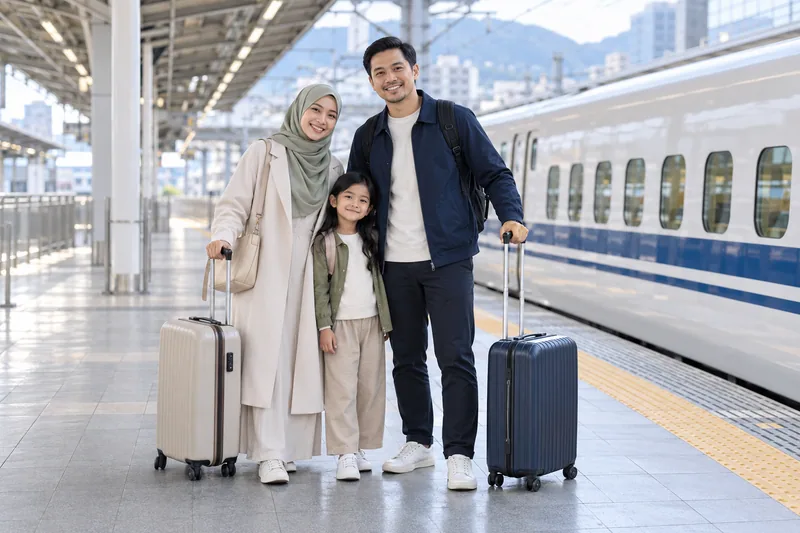
This plan gives you seven days across Tokyo, Kyoto and Osaka, with one certified meal anchor and one prayer anchor in each city. It suits first-timers who keep a strict halal standard. Check prayer windows on your app each day.
Who is this plan for?
It is for travellers who will not accept a pork-free menu as enough, and who would rather plan lunch than hope. It is an outline, not a booking. Because there is no central halal agency in Japan, you check each provider’s claim yourself3.
The route at a glance
- Day 1: Arrive in Tokyo, rest.
- Day 2: Tokyo Camii and Shibuya.
- Day 3: A slow Tokyo day, then pack.
- Day 4: Shinkansen to Kyoto, easy afternoon.
- Day 5: Kyoto temples and a long rest.
- Day 6: Osaka at a gentle pace.
- Day 7: Fly home from Kansai.
What do Malaysians need to enter Japan?
Malaysians do not need a visa for a short stay of less than 90 days1. You can pre-register immigration and customs information on Visit Japan Web2. Check the official page before you fly.
Japan is 1 hour ahead of Malaysia17, so set your prayer app to local time. Police are 110 and fire or ambulance 11918. Malaysia Airlines lists Tokyo13 and Osaka Kansai14 from Kuala Lumpur, so an open-jaw ticket is worth pricing.
How do you eat on this route?
JAKIM recognises six Japanese bodies, including the Japan Muslim Association and the Japan Halal Foundation4. Choose a restaurant that shows a certificate from one of them, and check that it covers this branch and has not expired.
Be careful with mirin, cooking sake and some miso, since JNTO warns they are used in Japanese dishes and may contain alcohol5. A restaurant that calls itself halal-friendly may not have a separate halal-only kitchen6. Treat such a claim as unconfirmed and ask.
Day by day
Day 1: Arrive in Tokyo
Haneda Terminal 2 has two prayer rooms on 3F International in the general area11, while Terminal 1 has none12. Check your terminal first. Ride to the hotel, pray, rest, and eat something you have already checked.
Day 2: Tokyo Camii and Shibuya
Plan the morning around Tokyo Camii in Shibuya, first built in 19388, with the current building completed in 20009. Message ahead about visiting hours, and pray Zohor there if you can.
Your Tokyo meal anchor is a certified lunch. After Asar, wander Shibuya at an easy pace. Go back to the hotel before the evening crowds.
Day 3: A slow Tokyo day
Keep one outing only, such as a temple area in the morning. Return for Zohor and rest. In the afternoon, pack and send large bags ahead by luggage forwarding. Eat early.
Day 4: To Kyoto
Take the shinkansen after breakfast. Reserve seats and carry a daypack. Eat your meal anchor before you board, because station food needs checks too.
Arrive, pray Zohor at the hotel and keep the afternoon light. A short walk through a quiet street is enough.
Day 5: Kyoto
Go to the temples early, when it is quiet. Return for Zohor and a long rest. For lunch, use your Kyoto anchor, a certified restaurant you have found beforehand. After Asar, take a short evening walk.
Day 6: Osaka
Move to Osaka after breakfast, and drop bags at the hotel. Visit the castle grounds in the afternoon, at your own pace. For dinner, use your Osaka anchor.
If your energy is good, Kobe Mosque, founded in 193510, is a worthwhile detour for another prayer anchor. Skip it if the group is tired.
Day 7: Fly home
Pray Subuh, eat a breakfast you have checked and leave for Kansai Airport with margin. Do not buy meat snacks as gifts, since Japan prohibits even heat-treated meat products15 and the penalty can reach three million yen or three years in prison16.
Where should you stay?
Choose an area near a station on your day-trip line in each city, not a famous district. In Tokyo, near Shibuya makes Day 2 easy. In Kyoto, pick a quiet area, and in Osaka, near the main station. Ask each hotel for a room with a clear qibla direction, which is the direction you face to pray.
How to adjust this plan
- Shorter: drop Osaka and add a night to Tokyo and Kyoto.
- Slower: keep one sight per day and one rest afternoon.
- With older parents: reduce temple stairs and use taxis for the last stretch.
- Strict standard: book three nights in a city where your meal anchors are close.
What to confirm in writing
Ask your agent to write down the meal anchors, which are certified and which are only pork-free, plus the prayer breaks. Our Japan halal meal-request guide gives the wording to send. See prayer rooms at Japanese transit hubs for the airports and stations.
Prayer rooms and mosques are mostly in larger cities7, so plan your temple days around that. Read Muslim travel in Japan, then the city pages for Tokyo, Kyoto and Osaka. Browse more Muslim tour packages if you want a guided option.
Share your dates, how strict your halal standard is and whether you are travelling with older parents, and we can rework this route and draft the meal and prayer questions for your agent.
Common questions
Is seven days enough for Tokyo, Kyoto and Osaka?
Seven days works as a first trip if you accept three bases and no more than one major sight per half-day. Three nights in Tokyo, two in Kyoto and one in Osaka leaves room for rest and prayer. If you want a slower trip, drop Osaka and add a night to each of the first two cities.
Should we fly into Tokyo and out of Osaka?
It saves a backtrack, and both cities appear on Malaysia Airlines' destination list from Kuala Lumpur. Ask your agent to price an open-jaw ticket against a return ticket, then compare. Leave time on the last day to reach Kansai Airport without rushing Zohor.
How do we eat when no certified restaurant is on our path?
Plan a fallback before you leave. Pack permitted snacks, buy fruit or plain rice dishes, and ask staff about mirin, cooking sake and broth. Treat any answer you cannot confirm as unknown. Do not carry meat snacks, since Japan prohibits them even when heat-treated.
Where can we pray between sights?
Plan on your hotel room, a prayer room you have found beforehand and Tokyo Camii in Shibuya. Prayer rooms and mosques are mostly in larger cities, so a village or temple day needs a plan. Whether to combine prayers while travelling is a question for your ustaz.
Can we take the shinkansen with children and parents?
Yes, if you reserve seats and leave an hour at each end. Ask your hotel about luggage forwarding between cities so you carry only a daypack. Eat before you board, since station food needs the same checks.
What should we confirm before we book?
Confirm the hotel rooms, the meal anchors on each city day and the prayer plan in writing. Our Japan meal-request guide gives the wording to send. Confirm the entry steps on the official Japanese pages, since they can change.
Sources
- Malaysian citizens do not need a visa to enter Japan for a short-term stay of less than 90 days, effective 11 October 2022. Embassy of Malaysia, Tokyo (kln.gov.my)
- Visit Japan Web, run by Japan's Digital Agency since 1 November 2022, lets travellers pre-register immigration and customs information and show QR codes at checkpoints, while paper forms are still accepted. ANA (airline) summarising Digital Agency. Airline page, not Digital Agency; confirm on official channel
- Japan National Tourism Organization's Muslim travellers page states there is no central agency for halal accreditation in Japan, so travellers should check each provider's claims. JNTO (japan.travel), Muslim travelers
- JAKIM's 21 August 2026 list recognises six Japanese bodies: Japan Muslim Association (JMA), NPO Japan Halal Association (JHA), Japan Islamic Trust (JIT), Muslim Professional Japan Association (MPJA), Nippon Asia Halal Association (NAHA) and Japan Halal Foundation (JHF). JAKIM, Recognized Foreign Halal Certification Bodies & Authorities (effective 21 August 2026)
- JNTO warns that cooking sake and mirin are used in many Japanese dishes, and some miso contains alcohol unless labelled additive-free (mu-ten-ka). JNTO (japan.travel), Muslim travelers
- JNTO notes that restaurants calling themselves halal-friendly may not have a separate halal-only kitchen, and that alcohol is served in most Japanese restaurants. JNTO (japan.travel), Muslim travelers
- JNTO says prayer rooms and mosques are mostly in larger cities, with major airports, tourist hotspots and Muslim-friendly hotels increasingly offering places to pray. JNTO (japan.travel), Muslim travelers
- Tokyo Camii in Shibuya, Tokyo was first built in 1938 alongside an adjoining school. Wikipedia
- The current Tokyo Camii building was completed in 2000 and inaugurated on 30 June 2000. Wikipedia
- Kobe Mosque in Kobe, Hyogo was founded in October 1935 after construction began in 1928. Wikipedia
- Haneda Terminal 2 has two prayer rooms on 3F International in the general (landside) area. Tokyo Haneda Airport official site
- Haneda Airport's official site lists no prayer room in Terminal 1. Tokyo Haneda Airport official site
- Malaysia Airlines' destinations list includes Tokyo (Narita International Airport and Haneda Airport) from its Kuala Lumpur hub. Wikipedia: Malaysia Airlines destinations. seasonal/subject to change
- Malaysia Airlines' destinations list includes Osaka Kansai International Airport from its Kuala Lumpur hub. Wikipedia: Malaysia Airlines destinations. seasonal/subject to change
- Japan's MAFF states that you are generally prohibited from bringing even heat-treated meat products into the country. MAFF Japan: Animal Quarantine Q&A
- Japan's MAFF states that attempting to illegally bring in such goods is subject to a fine of up to three million yen or imprisonment for up to three years. MAFF Japan: Animal Quarantine Q&A
- Japan is on UTC+09:00, 1 hour ahead of Malaysia (Malaysia is UTC+08:00). Wikipedia: List of time zones by country. Offsets exclude any daylight saving.
- Japan's national tourism organisation (JNTO) lists 110 for police and 119 for fire and ambulance. JNTO
Keep planning
Share your dates, how strict your halal standard is and whether you are travelling with older parents, and we can rework this route and draft the meal and prayer questions for your agent.