Plan sightseeing around the five daily prayers
You want to see the sights and still pray on time, without rushing either one.
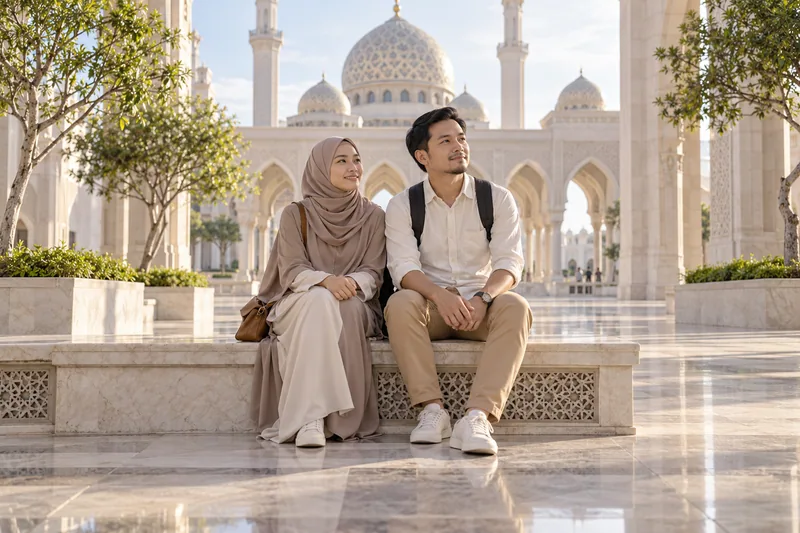
Plan the prayers first and let the sights fill the space between them. When Zohor, Asar and Maghrib are fixed points on the day, you stop doing sums at every attraction. Here is a template you can repeat in any city.
What does a prayer-first day look like?
Think of the day as blocks, not hours. Each block ends at a place where you can pray.
- Before leaving the hotel: Fajr (Subuh), unhurried, with breakfast after.
- Morning block: your biggest or farthest sight, while energy is high.
- Midday anchor: Zohor, and Asar too if you combine them within your own scholar’s guidance. Pick a place with a washbasin.
- Afternoon block: a lighter sight, shops or a park, ending near your Asar and Maghrib spot.
- Evening block: dinner and a walk, with Isha either at the hotel or at a mosque you have already found.
The hotel becomes your base for the first and last prayers. The two prayers in the middle are the ones that need planning.
How do I find the right anchor for the midday prayer?
Look for a prayer room, mosque or quiet space near where you will be at midday, and confirm it before you go. Prayer facilities are uneven. The Japan National Tourism Organization (JNTO) says prayer rooms and mosques are mostly in larger cities, with airports, tourist hotspots and some hotels increasingly offering places to pray1. That is Japan, but the pattern of big-city clusters and gaps between them applies well beyond Japan.
Use this test for each candidate stop:
- Is it on the way, or does it add a detour?
- Is there somewhere to make wudu nearby?
- Is there a separate or screened space for women?
- Can the whole group fit at the time you arrive?
If the answer to two or more is no, move the stop or plan to pray at the hotel. Our prayer-stop itinerary checklist lets you tick these off for every day.
How do I stop the morning from becoming a rush?
Decide the night before. Set out your clothes, prayer items, the day’s bag and a small towel, and agree who uses the bathroom first if you share a room. Wake before the group meets for breakfast, not after.
Then look at the next day’s Fajr and Zohor windows once, and write the window names beside the first and second sight. If the first sight is far, push it later and keep the near one for the morning.
What if my companions pray at different speeds?
Name it before the trip. A family can include someone who prays quickly, someone who needs a seat, and children who need a reminder. Build the midday anchor for the slowest person, then let the faster ones use the spare time for tea or a short walk.
How do I avoid backtracking between sights?
Group the sights by neighbourhood and put the prayer anchor in the middle of each group. Walking away from a cluster just to pray, and then walking back, eats the afternoon. Prayer times in Asia compared with Malaysia explains why windows differ, and the guide to prayer rooms at Japanese transit hubs shows how to read a station’s facilities in advance.
What about days that cannot be planned, like theme parks?
Event days need a different pattern, with the prayer break built into the park plan. Read the theme park and festival day prayer plan for that.
Your next step
Pick one city on your list. Mark the prayer windows on a blank day, place one anchor, and fit the sights around it. Then browse prayer and daily pacing for the harder cases: early starts, long days and short ones, fasting, children and older parents.
Send us the cities and the days you have, and we can mark your Zohor and Asar anchors on a draft route before you pay for anything.
Common questions
How do I know the prayer windows in a country I have never visited?
Use a prayer-times app set to your hotel's city, and check it again each morning because the windows move through the year. Write the window names on your itinerary, such as Zohor to Asar, instead of clock times. If you also use the Malaysian timetable by habit, remember the abroad timings will differ.
Should I pray at the sight or go back to the hotel?
Choose by what is closest and calm. A prayer room, a mosque or a quiet corner you have confirmed is fine. If the next sight is far from all of them, it is simpler to pray at the hotel before you leave and again when you return.
What do I do if a tour bus will not stop for prayer?
Ask before you pay, and ask for a written answer. If the schedule has no stop at all, you can book a different tour or plan your own day. A fixed itinerary is hard to bend once you are on the road, so settle this at the quotation stage.
Is it all right to pray in a public place if there is no prayer room?
Some travellers do, but it depends on the place and on your own comfort. Look for a quiet corner, ask staff politely, and keep your belongings in front of you. If you are unsure about the ruling on where you may pray, ask your own ustaz or your state mufti office.
How early should I prepare my wudu on a long sightseeing day?
Do it at the last convenient stop with a washbasin, such as the hotel, a station toilet or a mosque. Then keep track of whether you have broken it. Carrying a small towel and a bag for wet socks makes the next round easier.
Sources
- JNTO says prayer rooms and mosques are mostly in larger cities, with major airports, tourist hotspots and Muslim-friendly hotels increasingly offering places to pray. JNTO (japan.travel), Muslim travelers
Keep planning
Send us the cities and the days you have, and we can mark your Zohor and Asar anchors on a draft route before you pay for anything.