Muslim tour packages, checked line by line
You have two package offers open and cannot tell which one means what it says.
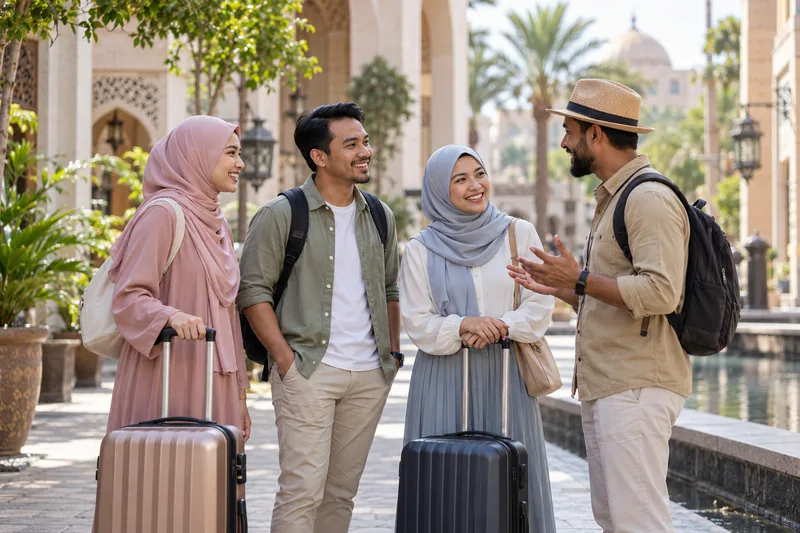
A Muslim tour package can mean a full plan for meals and prayer, or a brochure with the word on the cover. This hub gathers every page on comparing packages, reading their wording, handling meals and prayer on the road, and buying a private tour.
We are a planning resource, not a tour operator. The pages help you ask better questions of the agency you choose. For a fiqh question such as jamak and qasar, ask your own ustaz or your state mufti office.
How should you use this hub?
Start with the first group to learn how to compare and what to put in writing. Then go to the country, guide, meal and prayer groups that match your route. If you are weighing a private tour, use that group. The sample itineraries at the end show what a planned day looks like.
How do you compare and check an offer?
These pages give you a method: read the wording, compare on one basis, spot weak promises, and confirm the agency itself.
- How to compare two Muslim tour packages day by day: Put two offers side by side, day by day, on the same basis.
- Reading a package’s halal and prayer wording line by line: Read the halal and prayer wording one line at a time.
- What a Muslim-friendly tour should include on paper: What a Muslim-friendly tour should list in writing.
- Red flags in a “Muslim-friendly” tour offer: Warning signs in an offer that uses the label loosely.
- Muslim tour package or do it yourself: who benefits from which: Who gains from a package and who is better off planning alone.
- Questions to ask a tour operator about halal meals before you pay: Questions to send the agent before you pay.
- Which dietary and prayer arrangements should be confirmed in writing?: The arrangements worth having in an email, not a phone call.
- How to check a Malaysian travel agency licence before you pay: How to confirm the agency itself is licensed.
What changes from country to country?
The same word on a brochure means different things in Korea, Japan, Turkey or Bali. These comparisons show what to check for each route.
- Comparing Muslim tours to Korea: what changes between packages: What changes between Korea packages, from meals to mosque stops.
- Comparing Muslim tours to Japan: Tokyo, Osaka and Kyoto routes: Tokyo, Osaka and Kyoto routes compared for halal and prayer fit.
- Comparing Muslim tours that include Xi’an and Xinjiang: what to check: What to check on tours that include Xi’an or Xinjiang.
- Comparing Turkey tours: halal by default but not always the same trip: Why Turkey tours still differ even when halal is the default.
- Comparing Uzbekistan and Kazakhstan tours for Muslim travellers: Uzbekistan and Kazakhstan packages compared for travellers like you.
- Comparing Vietnam and Cambodia tours: halal reliability on a multi-country route: How reliable halal stays across a multi-country route.
- Comparing Bali tours: what Muslim-friendly means on a Hindu island: What Muslim-friendly can mean on a Hindu island.
Who leads and guides the group?
The guide shapes how meals and prayer actually go. These pages cover language, roles, prayer knowledge and group size.
- Muslim tour guides: Malay, Mandarin or local, and what to ask: Malay, Mandarin or local guide, and what to ask.
- Tour leader from Malaysia versus local guide: who does what: Who handles the group and who knows the place.
- Will the guide know prayer times and mosques? Questions to ask: Questions that reveal whether the guide knows prayer rooms.
- How tour group size changes pace, meals and prayer flexibility: How group size shapes pace, meals and prayer flexibility.
- Muslim-aware guides in Japan: how rare, how to ask: How rare Muslim-aware guides are in Japan and how to ask.
- Korea tours with Malay or Indonesian speaking guides: what is realistic: What is realistic when you want a Malay or Indonesian speaker.
What happens to meals on tour?
Meals are where a promise is tested. These pages cover substitutions, road lunches, flights, hotel breakfast and packed meals.
- Which meal substitutions need written confirmation?: Which swaps need written confirmation before you accept them.
- The restaurant is replaced on the day: your options: Your options when the restaurant changes on the day.
- Seafood or vegetarian meals as a substitute on a tour: how safe is it: How safe seafood or vegetarian is as a fallback.
- Lunch stops on a road day: why the choice shrinks: Why lunch choices shrink on a road day.
- Flight meals on a Muslim tour: ordering the special meal and what comes: Ordering the special meal and knowing what arrives.
- Hotel breakfast on tours: what the package really promises: What the package really promises at the hotel breakfast.
- Boxed lunches and packed meals on tours: sourcing and sealing: Sourcing and sealing for boxed lunches.
How do you keep prayer on the plan?
Prayer needs time and a place. These pages cover coach stops, dawn departures, Friday, combined prayers and free days.
- How flexible are prayer stops on a Muslim tour package?: How much room a package leaves for prayer stops.
- Stopping the coach for prayers: who decides and how to ask: Who decides when the coach stops and how to ask.
- Early coach departures and fajr: planning dawn prayers on tour: Planning dawn prayers around early coach departures.
- Friday prayer on a tour day: how to plan for it: Planning for Friday prayer on a tour day.
- Combining prayers on tour days: planning for jamak and qasar: Combining prayers on tour days, with a note to ask your ustaz.
- Prayer space at big tour sites: reading what exists before you go: Reading what prayer space exists at big sites before you go.
- Free-and-easy days on a package: who handles halal and prayer?: On free days, who handles halal and prayer.
Is a private tour the better choice?
A private tour moves the planning to your brief. These pages cover the questions, the request, the fit and the price.
- Buying a private tour for the first time: 12 questions to ask before you say yes: Twelve questions before you say yes to a private tour.
- How to brief an agent for a private tour in Asia: How to brief an agent so the quote fits your family.
- Writing a day-by-day halal meal plan into a private tour request: Writing a day-by-day meal plan into the request.
- Private tour vehicle and guide fit: matching size, language and pace to your family: Matching vehicle size, guide language and pace to your family.
- What drives the price of a private tour from Malaysia: What moves the price of a private tour from Malaysia.
- Single and low-season supplements in private tours: what hides in the price: Single and low-season supplements that sit inside the price.
- Booking a private guide who understands halal in Japan: Booking a private guide who understands halal in Japan.
What else should you check around the trip?
Timing, pace, paperwork, cover and the needs of particular travellers also decide how the package feels.
- Raya and school-holiday departures: what changes in Muslim packages: What changes in packages around Raya and school holidays.
- Reading a tour’s pace: coach hours and stops per day: Reading a tour’s pace from coach hours and daily stops.
- Forced shopping stops and optional tours on Muslim packages: Forced shopping stops and optional tours, and how to say no.
- Visa and entry on a Muslim tour: who handles what, and what to verify yourself: Who handles visas and what you still verify yourself.
- Travel takaful or insurance for a Muslim tour: what to compare: What to compare in travel takaful or insurance.
- Fasting on a tour or travelling during Ramadan: what a package can arrange: What a package can arrange when you fast or travel in Ramadan.
- Sending parents in their seventies on a Muslim tour: what to check: What to check before sending parents in their seventies.
- Joining a group tour alone as a Muslim woman: single supplement, roommate and safety: Single supplement, roommate and safety for a solo woman.
What do planned routes look like?
Each sample itinerary shows prayer windows, meals by claim state and rest built in. Use them to test an agent’s schedule.
- 5 days in Seoul with prayer stops and halal meals: Seoul with prayer stops and halal meals planned in.
- 7 days Tokyo, Kyoto and Osaka for halal-strict travellers: The classic Japan loop for halal-strict travellers.
- Slow-pace Hokkaido for older parents: A slow Hokkaido route for older parents.
- 8 days Istanbul and Cappadocia with prayer on the move: Istanbul and Cappadocia with prayer on the move.
- 7 days Uzbekistan Silk Road: Tashkent, Samarkand and Bukhara: Tashkent, Samarkand and Bukhara in one week.
- 4 days Tashkent and Samarkand: a fast first Central Asia trip: A fast first Central Asia trip.
- 4 days Xi’an: Muslim Quarter, Great Mosque and Terracotta Army: Xi’an’s Muslim Quarter, Great Mosque and Terracotta Army.
- 6 days in Jordan: Amman, Petra and Wadi Rum: Amman, Petra and Wadi Rum in six days.
- 5 days Bangkok and Hat Yai from Penang: a short Thai break: A short Thai break from Penang.
- 5 days Taipei with prayer and halal meals: Taipei with prayer and halal meals.
- Java in 7 days: Yogyakarta and Bandung for Muslim travellers: Java by way of Yogyakarta and Bandung.
Where next?
Put your quotes into the Muslim-tour inclusion comparator and plan stops with the prayer-stop itinerary checklist. For the tools together, see the planning tools hub, or return to the topics page.
Send us the two offers you are weighing and who is travelling, and we will help you mark which promises are in writing and which questions to send the agent.
Common questions
How do I compare two Muslim tour offers fairly?
Use the same basis for both: the same days, meals, prayer stops, guide and group size. Write each claim in one line and mark whether it is a promise in writing or only a word. The day-by-day comparison guide and the inclusion comparator tool walk you through it.
What makes a tour "Muslim-friendly" on paper?
A written list of what is arranged: halal meal handling, prayer time at stops, a guide who knows prayer rooms and what happens when a restaurant changes. A label alone is not enough. Look for each item as a sentence in the itinerary or confirmation.
Is a private tour worth it for my family?
It can be, when your family has different needs, such as older parents, young children or a strict meal rule. The private tour pages explain what drives the price and what to put in the request. A group suits you better when cost matters most and the route is simple.
Who decides whether the coach stops for prayer?
Usually the tour leader and driver, within the day plan, so ask before booking. The coach-stop page lists the wording to use. Ask how long each stop is, who checks the prayer room and what happens on long road days.
What should I get in writing before I pay?
Meal arrangements, prayer stops, the guide arrangement, hotel and room terms, and what happens if a restaurant is replaced. The page on written confirmation gives the list. Keep the email, not only the phone call.
Where do the sample itineraries fit in?
They show how meals and prayer can be planned into real routes in Asia. Use them as a reference when you read an agent's schedule: where does it leave time for Zohor and Asar, and who finds the lunch?
Keep planning
Send us the two offers you are weighing and who is travelling, and we will help you mark which promises are in writing and which questions to send the agent.