Halal food and meal checks
You are standing at a menu abroad and want to know what you can safely eat.
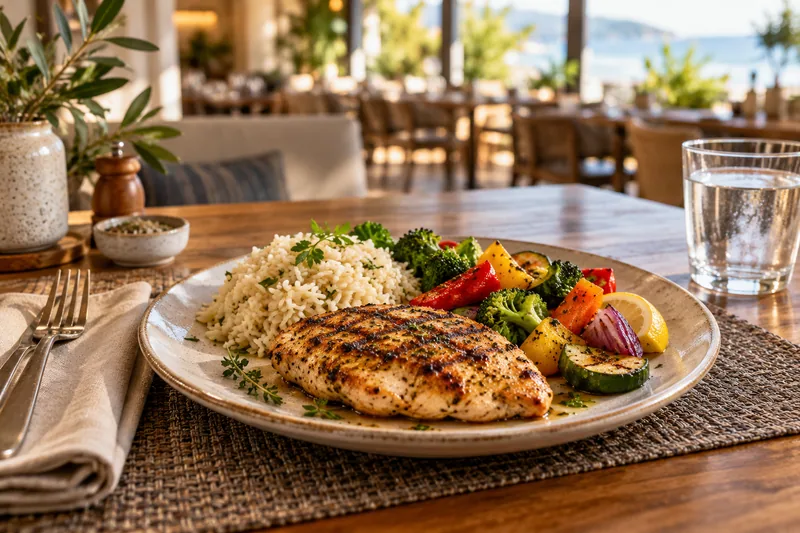
Halal food abroad is a chain of small checks: what the sign says, who issued the certificate, how the kitchen runs and what is in the sauce. This hub gathers every one of them.
No page here calls a named restaurant halal. Each one teaches you to separate certified, declared, Muslim-owned, Muslim-friendly, pork-free and unknown, then decide by your own standard or your ustaz’s advice.
How should you use this hub?
Read the first group once, because it sets out the words used everywhere else. Then open the group that matches where you are in the trip: booking a tour, choosing a hotel, standing at a night market or packing a snack. Every page ends with a question to ask or a message to send.
What do the words on the sign actually mean?
Seven pages set out the claim states and the traps in menu wording, apps and logos. Read these first.
- Certified, declared, Muslim-owned, pork-free, unknown: the five halal claim states: The six claim states side by side, with what each leaves unchecked.
- Halal-certified vs Muslim-friendly: which one are you actually getting?: Which of the two you are actually getting at a restaurant or hotel.
- Muslim-owned is not the same as halal-certified: when it matters: When Muslim ownership is enough for you and when it is not.
- Pork-free vs halal: the difference that changes what you can eat: Why a menu without pork can still hold lard, alcohol or shared tools.
- Muslim-friendly, no pork, no lard, halal ingredients: menu wording decoded: Menu phrases such as no pork, no lard and halal ingredients, decoded.
- Red flags in ‘Muslim-friendly’ travel claims: The warning signs in a Muslim-friendly travel claim.
- How reliable are halal restaurant apps and map listings?: How far to trust halal restaurant apps and map listings.
How do you check a halal certificate, country by country?
Fourteen pages explain what a certificate should show, which bodies JAKIM recognises, and how each country’s label works.
- How to check a halal certificate in another country before you eat: The steps to check a certificate in another country before you eat.
- Which Asian halal certifiers does JAKIM recognise, and what does that mean on holiday?: Which Asian certifiers JAKIM recognises, and what that means on holiday.
- The halal certificate on the wall looks expired: what should you do?: What to do when the certificate on the wall looks expired.
- Reading halal logos and certificate photos: spotting what is missing: How to spot what is missing on a halal logo or certificate photo.
- Certified kitchen or certified dish? Why the difference changes your meal: Why a certified dish and a certified kitchen are different.
- Japan halal certification: who issues it and how strict is it?: Who issues halal certification in Japan and how strict it is.
- Taiwan halal certification: how to read it in restaurants and shops: How to read Taiwan halal certificates in restaurants and shops.
- Thailand halal certification: reading the CICOT and provincial committee marks: Reading the CICOT and provincial committee marks in Thailand.
- What ‘qingzhen’ means on Chinese restaurants and how far to trust it: What qingzhen means on Chinese restaurants and how far to trust it.
- Turkey helal labels: why most food is not labelled and what to look for: Why most food in Turkiye is not labelled, and what to look for.
- Halal certification in Vietnam: what exists and what is only a sign: What halal certification exists in Vietnam and what is only a sign.
- Dubai halal rules: what the municipality oversees and what it does not: What the Dubai municipality oversees and what it does not.
- Halal in India and Kashmir: labels, local norms and what to ask: Halal labels, local norms and what to ask in India and Kashmir.
- MUIS halal in Singapore: eating out on a Johor Bahru day trip or layover: MUIS halal eating on a Johor Bahru day trip or layover.
What does a tour or flight really promise about meals?
Thirteen pages cover the wording of tour promises, who verifies meals and how to ask for evidence.
- ‘Halal meals provided’ on a tour package: what does it really promise?: What a “halal meals provided” line on a package really promises.
- Questions to ask a tour operator about halal meals before you pay: The questions to put to a tour operator before you pay.
- Who verifies the halal meals on a group tour, and how?: Who checks the meals on a group tour, and how.
- A message template to ask an operator for halal meal evidence: A message template to ask an operator for halal meal evidence.
- Private tour and driver: who chooses lunch, and how to control it: Who chooses lunch on a private tour, and how to keep control.
- Airline ‘Muslim meal’ or ‘halal meal’? What you get on Asian flights: What the airline Muslim meal and halal meal options actually are.
- Pre-ordering halal meals on flights from Malaysia to Asia, step by step: Step-by-step pre-ordering of halal meals on flights to Asia.
- Japan ‘Muslim-friendly’ restaurant labels: what the sign can and cannot tell you: What a Japan Muslim-friendly sign can and cannot tell you.
- Korea tour meal stops: how halal arrangements usually work on coach tours: How halal arrangements work at Korean coach-tour meal stops.
- A Muslim restaurant in China is not always a halal-certified one: Why a Muslim restaurant in China is not always certified.
- Vietnam tours: how to test a halal meal claim in Hanoi, Hoi An and Ho Chi Minh City: How to test a halal meal claim in Hanoi, Hoi An and Ho Chi Minh City.
- Uzbekistan and Kazakhstan tour meals: what ‘halal’ means in a Muslim-majority setting: What halal means on Uzbekistan and Kazakhstan tours.
- Bali tour operators and halal claims: Hindu-majority island, what to verify: What to verify with Bali operators on a Hindu-majority island.
How do you eat on day trips, transfers and layovers?
Five pages cover the meals that fall between the main plans.
- Halal meals on island and boat day trips: Phuket, Krabi, Bali and the Philippines: Meals on island and boat trips in Phuket, Krabi, Bali and the Philippines.
- Halal lunch on Thailand day tours from Bangkok, Phuket and Chiang Mai: Halal lunch on Thailand day tours from Bangkok, Phuket and Chiang Mai.
- Halal food at theme parks and big attractions in Asia: Finding halal food at theme parks and big attractions in Asia.
- Halal food on long coach transfers and highway rest stops: Halal food on long coach transfers and highway rest stops.
- Airport food courts in Asia: finding a halal meal during a layover: Finding a halal meal at Asian airport food courts during a layover.
What should you ask a hotel about breakfast?
Eight pages cover the general questions, the buffet traps and what to do when breakfast fails.
- Hotel breakfast on a Muslim trip: what to ask before you book: What to ask before you book a hotel for the breakfast.
- Email template: asking a hotel about halal breakfast: An email template for asking a hotel about halal breakfast.
- Pork on the hotel buffet: separate counters, shared tongs and what that means: What separate counters and shared tongs mean on a buffet with pork.
- Alcohol served in the hotel restaurant: can the kitchen still suit you?: Whether the kitchen can suit you when the hotel serves alcohol.
- Hotel room kettle and mini-fridge: a halal-safe breakfast you assemble yourself: A breakfast you assemble yourself from a kettle and mini-fridge.
- Early flight, no breakfast: asking the hotel for a halal packed breakfast: Asking a hotel for a packed breakfast before an early flight.
- Room service and halal requests: how to ask without awkwardness: How to ask room service about halal without awkwardness.
- Breakfast is included but not halal: refund, swap or eat outside?: Refund, swap or eat outside when breakfast is included but unsuitable.
What is hotel breakfast like in each destination?
Eleven pages go destination by destination, because the hidden pork, broth or alcohol changes with the cuisine.
- Hotel breakfast in Japan: eggs, rice and the hidden pork and broth: Eggs, rice and the hidden pork and broth in a Japanese breakfast.
- Korean hotel breakfast: what is safe to eat and what to skip: What is safe to eat and what to skip at a Korean hotel breakfast.
- Bangkok hotel breakfast: international hotels versus Muslim-run guesthouses: International hotels compared with Muslim-run guesthouses in Bangkok.
- Dubai hotel breakfast: halal meat is standard, so what else should you check?: What else to check when halal meat is the standard in Dubai.
- Chinese hotel breakfast for Muslim travellers: noodles, congee and broths: Noodles, congee and broths at a Chinese hotel breakfast.
- Turkey hotel breakfast and all-inclusive resorts: what to confirm: What to confirm at Turkish hotel breakfasts and all-inclusive resorts.
- Bali resort breakfast: pork, bacon stations and what to ask: Pork, bacon stations and what to ask at a Bali resort breakfast.
- Maldives resort meal plans: full board, all-inclusive and halal assurance: Full board and all-inclusive plans on Maldives resorts, and halal assurance.
- Taiwan hotel breakfast: when vegetarian is the safer default: When vegetarian is the safer default at a Taiwan hotel breakfast.
- Hong Kong hotel breakfast and compact rooms: what is realistic: What is realistic at a Hong Kong hotel breakfast with compact rooms.
- Vietnam hotel breakfast: pho broth, banh mi and what to avoid: Pho broth, banh mi and what to avoid at a Vietnam hotel breakfast.
When are vegetarian and seafood meals a safe fallback?
Ten pages show how travellers decide, and where hidden ingredients undo the fallback.
- Vegetarian or halal-certified: how to choose at each meal: How to choose between vegetarian and a halal-certified meal at each meal.
- Is vegetarian food automatically halal? The hidden risks to know: Why vegetarian food is not automatically halal.
- Eating seafood only when nothing halal is available: how travellers decide: How travellers decide to eat seafood only when nothing halal is available.
- Why seafood only on a menu does not verify a suitable meal: Why “seafood only” on a menu does not verify the meal.
- Buddhist vegetarian restaurants in Taiwan: a practical fallback with caveats: Buddhist vegetarian restaurants as a practical fallback in Taiwan.
- Vegetarian in Japan: dashi, mirin and sake hide in ‘veggie’ dishes: Dashi, mirin and sake hiding in vegetarian dishes in Japan.
- Korean temple food and vegetarian restaurants as a fallback: Korean temple food and vegetarian restaurants as a fallback.
- Vegetarian India versus halal: planning meals beyond Kashmir: Planning meals in India beyond Kashmir, where vegetarian is not halal.
- Sri Lanka food for Muslim travellers: coastal seafood and Muslim-run eateries: Coastal seafood and Muslim-run eateries in Sri Lanka.
- Thailand seafood markets and pork-free dining: what is reasonable to expect: What is reasonable to expect at Thai seafood markets and pork-free places.
Which hidden ingredients and dishes need a second look?
Eight pages cover lard, mirin, wine, gelatine and the dishes where they turn up.
- Lard, mirin, cooking wine and gelatine: the hidden ingredients list: The hidden ingredients list: lard, mirin, cooking wine and gelatine.
- Gelatine and additives in packaged snacks and sweets abroad: Gelatine and additives in packaged snacks and sweets abroad.
- Shaoxing wine and Chinese cooking: dishes where it hides: The Chinese dishes where Shaoxing wine hides.
- Ramen, udon and soba in Japan: finding noodles without pork broth: Finding noodles in Japan without pork broth.
- Sushi and sashimi in Japan: seafood is fine, so what else to check: Seafood is fine at a sushi bar, so what else to check.
- Fish burgers and fries at global fast-food chains in Asia: shared fryer reality: The shared-fryer reality behind fish burgers at global chains in Asia.
- Bakeries and desserts abroad: lard, alcohol and gelatine in sweet treats: Lard, alcohol and gelatine in bakeries and desserts abroad.
- Flambe and cooking with alcohol in mixed restaurants: spotting it on the menu: Spotting flambe and alcohol cooking on a mixed restaurant’s menu.
How do shared kitchens and equipment affect a meal?
Eleven pages cover grills, fryers, spoons and stalls, the places where cross-contact happens.
- Cross-contamination: shared grills, pans and ladles explained: Shared grills, pans and ladles explained.
- Shared fryer oil: how to ask and what answer to accept: How to ask about fryer oil and what answer to accept.
- A ‘halal corner’ in a non-halal restaurant: how much comfort is reasonable?: How much comfort a halal corner in a non-halal restaurant is worth.
- Chinese Muslim restaurants: how their kitchens usually work: How Chinese Muslim restaurant kitchens work.
- Food courts with mixed stalls: seating, trays and shared washing: Seating, trays and shared washing at food courts with mixed stalls.
- Utensils and dishwashing: when plates are washed with non-halal items: When plates are washed together with non-halal items.
- Buffets and spoon mixing: how to reduce cross-contact at a buffet: How to reduce cross-contact at a buffet.
- Hot pot and shared broth: when it works and when it does not: When hot pot with shared broth works and when it does not.
- Korean BBQ and yakiniku: shared grills and what to do: Korean BBQ and yakiniku shared grills, and what to do.
- Night markets and street food: a risk-ranked guide for Muslim travellers: A risk-ranked guide to night markets and street food.
- Global fast-food chains in Asia: why halal status differs by country: Why halal status differs by country at global fast-food chains.
How do you ask, shop and eat with others?
Eight pages cover the practical side: cards to show, snacks to buy and tables to share.
- How to ask about halal in a restaurant where staff do not speak English: How to ask about halal when staff do not speak English.
- Translated dietary request cards for Japan, Korea and Thailand: Translated dietary request cards for Japan, Korea and Thailand.
- Self-catering at supermarkets abroad: what you can safely buy: What you can safely buy when self-catering at supermarkets abroad.
- Japan convenience stores: halal-friendly snacks and the ingredients that trip you up: Japanese convenience-store snacks and the ingredients that trip you up.
- Korea and Taiwan convenience stores: ready meals for Muslim travellers: Ready meals at Korean and Taiwanese convenience stores.
- Instant noodles abroad: reading flavour packets and halal logos: Reading flavour packets and halal logos on instant noodles abroad.
- Baby food and formula while travelling: ingredient checks for parents: Ingredient checks for baby food and formula while travelling.
- Eating out with non-Muslim friends or colleagues: choosing a table everyone can sit at: Choosing a table everyone can sit at with non-Muslim friends or colleagues.
Where to go next
Compare tour and hotel meal offers with the meal-assurance comparison tool, and turn your questions into one message with the dietary enquiry brief generator. For the paperwork side, see Halal labels and evidence and Booking and confirmation. If cost is the worry, read Costs and value.
Send us the menu, the tour itinerary or the hotel breakfast details you are unsure about, and we will help you work out which claim state it is and what to ask.
Common questions
What is the difference between halal-certified and Muslim-friendly?
Halal-certified means a recognised body has issued a certificate you can see. Muslim-friendly means some needs are considered, such as a prayer room or a halal dish, without certifying the kitchen. The first group below explains all six claim states and what each leaves unchecked.
How do I check a halal certificate in another country?
Photograph it and note the issuing body, the expiry date and the branch named. Then check the body against JAKIM’s list of recognised foreign bodies. The certificate pages below walk through the steps and show what to do when it looks expired or incomplete.
Is vegetarian or seafood automatically a safe choice?
No. Sauces can contain lard, alcohol or fish stock, and shared fryers and pans carry cross-contact. These are fallback options with limits, not halal by default. The vegetarian and seafood pages below show how travellers decide, and where the risk hides.
What should I ask a tour operator about meals?
Ask who prepares each meal, what evidence exists, and whether the same arrangement applies on every day of the tour. Request the answer in writing. The tour pages below give wording you can copy, and explain what a promise of halal meals really covers.
What if my hotel breakfast cannot be confirmed?
Treat the buffet as unknown, ask about separate counters and shared utensils, and plan a fallback you control, such as sealed items or a packed breakfast. The hotel pages below cover each destination and include an email template for asking the hotel directly.
Keep planning
Send us the menu, the tour itinerary or the hotel breakfast details you are unsure about, and we will help you work out which claim state it is and what to ask.