Hotel restaurant serves alcohol: can you eat there?
There is a bar beside the hotel restaurant, and you are unsure whether to sit down.
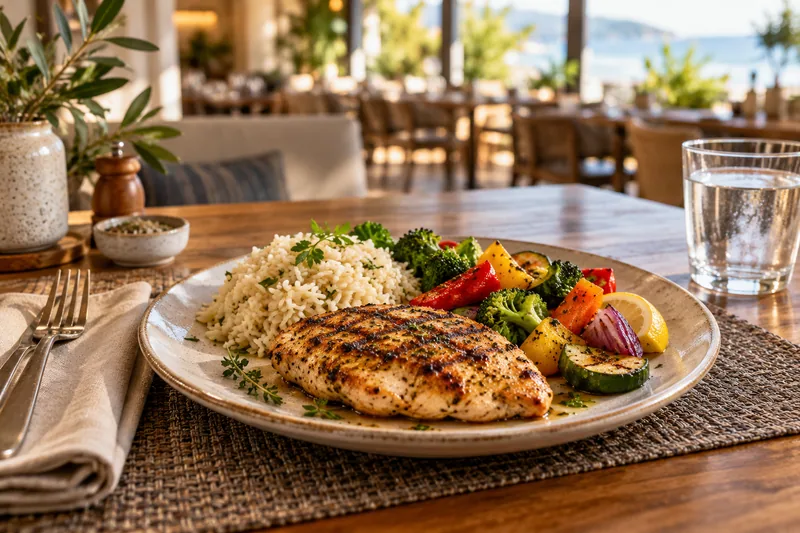
Alcohol on the premises does not settle the question either way. What matters is where alcohol touches your food and how close a line you personally draw. This page names those lines so you can choose, and for a ruling you can ask your own ustaz or your state mufti office.
Which decision line is yours?
Most worries about a hotel with a bar fall into three separate lines. Different people stop at different ones.
- Alcohol in the food: wine in sauces, flambé, spirits in desserts, mirin, cooking sake.
- Alcohol near the food: a bar beside the dining room, bar seating at breakfast, glasses on the next table.
- A shared kitchen: the same hob, oil, grill or utensils used for dishes with alcohol or pork.
None of these is the “right” line. They are three questions, and you can answer each one differently for a family dinner and a quick breakfast.
What does a Muslim-friendly label tell you?
Less than you might hope. The Korea Tourism Organization (KTO) says a restaurant in its “Muslim Friendly” category provides some halal dishes and may sell alcohol1. Its “Pork-free” category has no halal menu, does not use pork and may also sell alcohol2.
KTO also warns that hotel restaurants and buffets categorised as Muslim-friendly may serve dishes that contain pork3. In Malaysia, the Islamic Tourism Centre awards MFAR (Muslim-Friendly Tourism and Hospitality Assurance and Recognition) to businesses that meet its guidelines5. That sits in the Muslim-friendly claim state, not the certified one.
Where does alcohol hide in a kitchen?
Japan National Tourism Organization (JNTO) warns that cooking sake and mirin are used across Japanese cooking, and some miso contains alcohol unless it is labelled additive-free4. The same pattern appears elsewhere under other names: wine reductions, beer batter, vanilla extract, liqueur in cakes. A plain grilled fish can be clean while its glaze is not.
Which question settles which line?
Send these by email before you book, or show them at the table.
| Your line | Question to send |
|---|---|
| Alcohol in the food | “Do any dishes, sauces or desserts on the breakfast and dinner menus contain wine, beer, mirin, rum or other alcohol?” |
| Alcohol near the food | “Where is the bar in relation to the dining room, and is alcohol served at breakfast?” |
| A shared kitchen | “Are halal or pork-free dishes cooked on separate equipment from dishes with alcohol or pork?” |
| Proof | “Do you hold a halal certificate? Which body issued it, when does it expire, and does it cover this kitchen?” |
A good answer names specific dishes or equipment. “Yes, no problem” tells you nothing.
What if the answer is vague?
Treat the kitchen as unknown and decide by your own standard. You can eat outside, choose whole foods you can see, or ask the hotel to confirm the answer in writing. Our guide to hotel breakfast questions before you book covers the breakfast side in more detail.
When another stay suits you better
If a bar next to the dining room is your deciding line, tell the hotel at the start and compare properties on that point. Some countries have patterns worth knowing before you choose: see alcohol and mixed pools in Dubai hotels and alcohol in Turkish hotels and restaurants.
Your next step
Write your own line in one sentence, for example “No alcohol in the food, a bar in the building is fine”. Then fill in the dietary enquiry brief generator and send it with the hotel breakfast email template. To check the label itself, read the five halal claim states, or browse the halal food hub.
If your family cannot agree on where the line sits, tell us who is travelling and what each person accepts, and we will help you word one set of questions for the hotel.
Common questions
Does a bar in the hotel make the restaurant unsuitable?
Not by itself. A bar tells you alcohol is served on the premises, not how the kitchen works. For some travellers the bar alone is the deciding line, for others the food is what matters. Work out which group you are in before you book, then ask where the bar sits and what the kitchen does.
Is cooking wine the same as drinking alcohol?
That is a question of fiqh, and families answer it differently. We can tell you where cooking alcohol hides: sauces, marinades, flambé, desserts and some seasonings. Ask your own ustaz or your state mufti office where your line sits, then ask the kitchen a precise question.
What if the hotel says everything on the buffet is fine for Muslims?
Ask what that statement is based on. A certificate from a body you recognise is evidence. A staff member's reassurance is a declaration. Ask for the certificate, the issuing body and whether it covers this kitchen, and treat the answer as unknown until you see it.
Can my family eat here if we all draw the line differently?
Yes, if you agree it before you sit down. One person may accept a hotel with a bar but avoid dishes with wine, while another avoids the dining room at drinking hours. Write each person's line in one sentence and choose meals that satisfy the strictest one that day.
What should I do when I get no clear answer?
Treat the kitchen as unknown. Unknown is never the same as halal, and it is not a reason to feel awkward about asking. You can eat elsewhere, choose sealed or whole foods you can inspect, or ask the hotel to put the answer in writing before you decide.
Sources
- Korea Tourism Organization's four Muslim-friendly restaurant categories include Muslim Friendly: some halal dishes are provided and alcohol may be sold. Korea Tourism Organization (VisitKorea), Muslim-friendly Travel
- Korea Tourism Organization's four Muslim-friendly restaurant categories include Pork-free: the restaurant has no halal menu but does not use pork, and alcohol may be sold. Korea Tourism Organization (VisitKorea), Muslim-friendly Travel
- KTO warns that hotel restaurants and buffets categorised as 'Muslim-friendly' may serve dishes that contain pork. Korea Tourism Organization (VisitKorea), Muslim-friendly Travel
- JNTO warns that cooking sake and mirin are used in many Japanese dishes, and some miso contains alcohol unless labelled additive-free (mu-ten-ka). JNTO (japan.travel), Muslim travelers
- The Islamic Tourism Centre (ITC) Malaysia awards MFAR (Muslim-Friendly Tourism and Hospitality Assurance and Recognition) to tourism businesses meeting its Muslim-friendly guidelines. Islamic Tourism Centre (ITC)
Keep planning
If your family cannot agree on where the line sits, tell us who is travelling and what each person accepts, and we will help you word one set of questions for the hotel.