How to check a hotel's Muslim-friendly claim
The listing says Muslim-friendly, and you want to know what that rests on.
Start by sorting the hotel’s claim into one of five states, then ask for the proof that state needs. A listing that says “Muslim-friendly” has told you very little until you know which state sits behind it. It takes one short message.
Which state is the claim in?
| State | Who says it | Proof to ask for | Still unchecked |
|---|---|---|---|
| Certified | A recognised halal body | Certificate: issuer, expiry, scope | Whether it covers this kitchen and this meal |
| Operator-declared | The hotel itself | A written statement and supplier details | Everything an outsider could verify |
| Muslim-owned | The owner’s identity | Who runs the kitchen day to day | Ingredients, alcohol, shared tools |
| Pork-free | The menu | Cooking oil, sauces, shared equipment | Lard, alcohol, cross-contact |
| Unknown | Nobody | Nothing yet | All of it |
The five halal claim states page explains these in detail. Here the focus is on hotels.
What proof should I ask for?
Certified. Ask for the certificate photo. Read the issuer, the expiry date and the scope line, which says what the certificate covers.
Only JAKIM, MAIN or JAIN can issue the Malaysian halal certification and permit the official logo4. JAKIM says other logos implying halal status are invalid5. For foreign hotels, ask whether the issuer is on JAKIM’s current list.
Operator-declared. Ask the hotel to say in writing what it means by halal: pork, lard, alcohol in cooking, and where the meat comes from.
Muslim-owned. Ask who runs the kitchen and where ingredients are bought.
Pork-free. Ask whether the same oil, grill or utensils touch pork, and whether sauces contain alcohol.
Unknown. Ask once, in writing. If the reply is vague, treat the claim as unconfirmed.
What about official recognition in Malaysia?
Malaysia has its own recognition for hotels. The Islamic Tourism Centre awards MFAR to tourism businesses that meet its Muslim-friendly guidelines1. For accommodation it has three rating levels: Silver, Gold and Platinum2. Silver is for premises that comply with the general requirements and meet the basic needs of Muslim travellers3.
MFAR covers Muslim-friendly facilities. It is not a halal certificate for the hotel kitchen, so ask about food separately.
Does a Muslim-friendly label mean the buffet is safe?
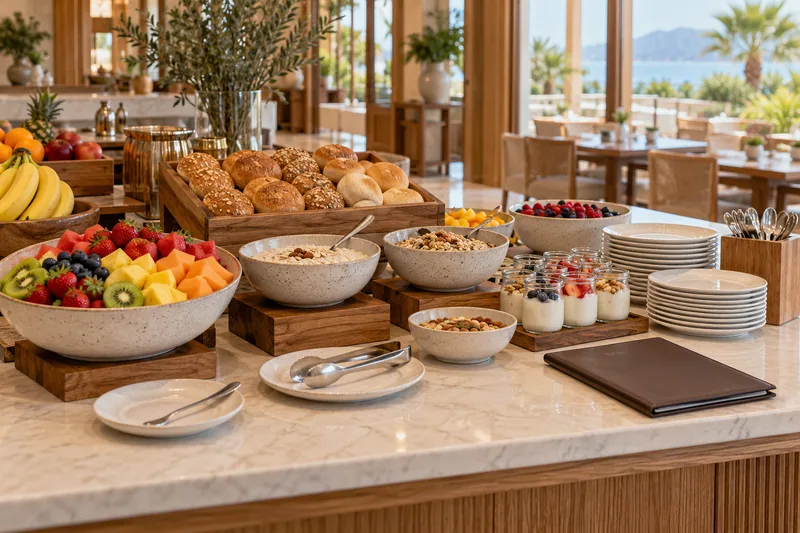
Not by itself. The Korea Tourism Organization warns that hotel restaurants and buffets categorised as Muslim-friendly may serve dishes that contain pork6. Ask whether breakfast is on a separate counter, what is served beside it and who handles the food.
What do I send the hotel?
Copy and adjust:
“Hello, I am a Muslim guest and want to confirm: (1) Do you hold a halal certificate? Please send the issuer, expiry date and scope. (2) Is pork or alcohol used in any dish at breakfast? (3) Is there a prayer room or qibla direction in the room? Please reply yes, no or unknown for each.”
The private-stay requirements builder lets you list your own needs first. Once you book, recheck the claim before you travel. Guest reviews are useful but are not proof, as this page on reviews explains. All of this sits in the hotels, rooms and privacy hub.
Send us the hotel link and your own rule for food and facilities, and we will help you turn the claim into three questions the hotel must answer.
Common questions
What does Muslim-friendly mean on a hotel page?
It means the hotel says it has considered some Muslim needs, such as a prayer room, a qibla sign or no pork at breakfast. It does not mean the kitchen is halal-certified. Ask which needs are covered, and ask for the evidence for each one.
Is a Muslim-owned hotel automatically halal?
No. Ownership tells you who runs the business, not how the kitchen works. A Muslim owner may run a careful kitchen, but unless you see a certificate you are relying on their word. Ask the same kitchen and supplier questions you would ask anywhere.
How do I read a halal certificate shown by a hotel?
Look at the issuing body, the expiry date and the scope line. Check whether the body is recognised by JAKIM for that country and whether the certificate covers the kitchen you will eat from. A logo with no body, or an expired date, counts as unknown until clarified.
What if the hotel will not answer?
Treat the claim as unknown, which is never the same as halal. Ask once in writing, wait for a reasonable time, and choose another property if you get only marketing language. A hotel that can answer clearly is easier to trust than one that cannot.
Do I need a Malaysian recognition like MFAR?
Not necessarily, but it is a useful official signal for hotels in Malaysia. It covers Muslim-friendly facilities, not a halal certificate for the kitchen. Treat it as one proof among others, and still ask about food.
Sources
- The Islamic Tourism Centre (ITC) Malaysia awards MFAR (Muslim-Friendly Tourism and Hospitality Assurance and Recognition) to tourism businesses meeting its Muslim-friendly guidelines. Islamic Tourism Centre (ITC)
- MFAR for tourist accommodation has three rating levels: Silver, Gold and Platinum. MyGovernment (malaysia.gov.my), List of Muslim-friendly hotels
- MFAR Silver is for tourist accommodation premises that comply with MFAR general requirements and meet the basic needs of Muslim travellers. MyGovernment (malaysia.gov.my), List of Muslim-friendly hotels
- Under the Trade Descriptions (Certification and Marking of Halal) Order 2011, only JAKIM, MAIN or JAIN can issue the Malaysian Halal Certification (SPHM) and permit use of the official Malaysian halal logo. New Straits Times (Nov 2025)
- JAKIM says logos or terms implying halal status issued by anyone other than JAKIM or MAIN/JAIN are invalid, and that 'Muslim Choice' is not a recognised halal label. New Straits Times (Nov 2025)
- KTO warns that hotel restaurants and buffets categorised as 'Muslim-friendly' may serve dishes that contain pork. Korea Tourism Organization (VisitKorea), Muslim-friendly Travel
Keep planning
Send us the hotel link and your own rule for food and facilities, and we will help you turn the claim into three questions the hotel must answer.