City or remote resort for your Muslim holiday
One of you wants a pool and quiet, the other wants mosques and food nearby.
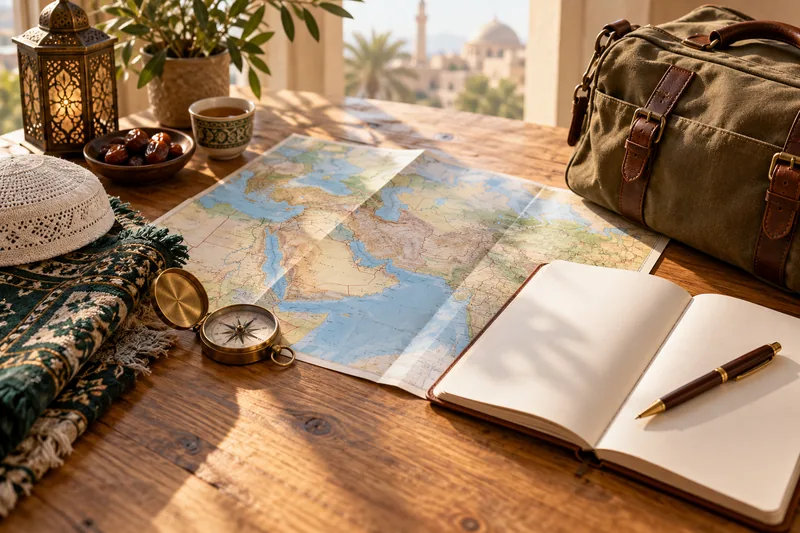
For most Muslim families, the choice comes down to what you want to be free of: a city frees you from arranging food and prayer in advance, while a remote resort frees you from noise and mixed spaces. Neither wins on every count. Below, both are tested under the same assumptions so the trade-off is visible.
What assumptions are we using?
We compare a family with children and one older parent, on the same dates and the same budget, with no private car. The resort is far from the nearest large town. The city base is a mid-town hotel with transit close by. Change the assumptions and the answer can change, so read this as a method, not a verdict.
Which option suits which traveller?
- Young children, short patience: a resort, if meals and prayer space are confirmed first.
- Older parents who tire quickly: whichever base needs the least walking between room, food and prayer.
- Strict about certified meals: a city, where you can switch venue if a claim does not hold.
- Mixed observance in one group: a city base with a quiet hotel, so each person can use the day differently.
- Privacy matters most: a resort, if the pool and beach arrangements are confirmed in writing.
How do the two compare?
| Question | City base | Remote resort |
|---|---|---|
| Choice of meals | Wide, but each claim needs reading | Narrow, one kitchen |
| If a meal fails | Walk to another venue | Few or no alternatives nearby |
| Prayer places | Mosques and prayer rooms are nearer | Depends on the resort |
| Water for wudu | Mosques provide it, hotels vary | Ask; it may be only in the room |
| Privacy | Lower, crowded streets | Higher, if pools are managed |
| Noise at night | Higher | Lower |
| Getting around | Transit, taxis | Resort transfers or a long ride |
One kitchen means a single point of failure for your meals. Ask the resort what it can do and get it in writing.
What does each option put on you?
A city puts the checking on you. Japan’s tourism body says prayer rooms and mosques are mostly in larger cities, with major airports, tourist hotspots and Muslim-friendly hotels increasingly offering places to pray1. That helps a city base, but a city also gives you more claims to judge. The same body notes that restaurants calling themselves halal-friendly may not have a separate halal-only kitchen3.
A resort puts the arranging on you. Meals come from one place, so the question is whether it can meet your standard. South Korea’s tourism body warns that hotel restaurants and buffets labelled Muslim-friendly may serve dishes containing pork2. A label on a resort is a starting point for questions, not an answer.
What should you confirm before choosing a resort?
Send these before you pay.
- “Which meals can you serve that meet halal requirements, and who certifies them?”
- “Where can guests pray, and is there water for wudu and a qibla marker?”
- “Are the pool and beach times for women or families arranged, and who confirms them?”
- “How do we reach a mosque or shop if a meal does not work?”
The private-stay requirements builder gathers these into one message. If the resort is remote, read when not to choose a remote destination first.
When does the other option win?
If a food trip is the point, a city with night markets can beat a resort. Our guide to night-market city or resort for food-first travellers covers that case. If rest is the point and the resort has confirmed meals and prayer space, the resort may be calmer for the whole family.
Your next step
Write down the strictest need in the group, then test both bases against it. Add a prayer-stop itinerary checklist to whichever you choose. For more on choosing a destination, see choosing where to go.
If you are torn between a city and a resort, tell us who is travelling and what each person needs, and we will help you test both options against the same checklist.
Common questions
Is a remote resort easier for a family with young children?
It can be, because the pool, meals and room are in one place and nobody has to move. The price of that ease is dependence: if the resort kitchen cannot confirm halal meals, you have few alternatives nearby. Ask about meals and prayer space in writing before you pay.
Is a city always better for halal food?
A city offers more choice, which helps, but choice is not proof. You still need to read each claim, and a restaurant near your hotel may be unknown rather than certified. The advantage of a city is that you can switch venues if an answer is poor.
Where is it easier to find a place to pray?
Prayer rooms and mosques are easier to find in larger cities, at major airports and at tourist spots. A resort may offer a room or none at all. Ask what space exists, whether there is water for wudu, and where the qibla points.
How do I handle a mixed group with different needs?
Pick the base that covers the strictest member's needs without making the others miserable. A city base with a quiet hotel can suit a mixed group. A resort suits it only if privacy and meals are already confirmed and nobody is bored on day two.
What if I want both a city and a resort in one trip?
Split the trip into two stays and treat each as its own plan. Do the city first when you have the most energy and the resort at the end for rest. Each switch repeats your meal and prayer checks, so keep to two bases.
Sources
- JNTO says prayer rooms and mosques are mostly in larger cities, with major airports, tourist hotspots and Muslim-friendly hotels increasingly offering places to pray. JNTO (japan.travel), Muslim travelers
- KTO warns that hotel restaurants and buffets categorised as 'Muslim-friendly' may serve dishes that contain pork. Korea Tourism Organization (VisitKorea), Muslim-friendly Travel
- JNTO notes that restaurants calling themselves halal-friendly may not have a separate halal-only kitchen, and that alcohol is served in most Japanese restaurants. JNTO (japan.travel), Muslim travelers
Keep planning
If you are torn between a city and a resort, tell us who is travelling and what each person needs, and we will help you test both options against the same checklist.